A truck-mounted CME-75 drill rig with hollow-stem augers and a split-spoon sampler is usually the first piece of equipment on site when we start a soil mechanics study in Surprise. The city sits at roughly 1,175 feet elevation on the broad Sonoran Desert bajada, where Holocene alluvium and occasional lenses of caliche hardpan control how foundations behave. Our crew runs standard penetration tests per ASTM D1586 in the boring, then logs the cuttings against the Unified Soil Classification System (ASTM D2487). That sequence—drilling, sampling, logging—gives us the raw data we need to build a subsurface model. For deeper layers or when the augers hit coarse gravel typical of the White Tank Mountain fans, we switch to rotary wash boring to keep the hole open. Every boring log ties back to the Maricopa County floodplain maps and Surprise grading ordinances, so the triaxial shear data we generate later actually matches what the contractor will excavate. We also coordinate with the CPT test crew when the site access is tight and we need continuous tip resistance profiles without bringing cuttings to the surface.
Surprise caliche can fool you—it drills like rock but weathers like soil, and the difference shows up in the consolidation curve.
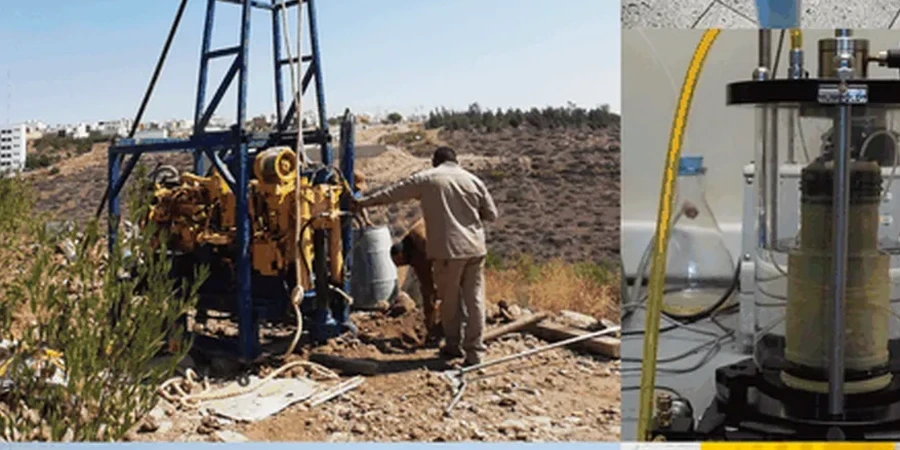
Technical details of the service in Surprise Arizona
Live process video
Local geotechnical conditions in Surprise Arizona
Sites near the original Surprise townsite, roughly bounded by Greenway and Bell Roads, sit on older, denser alluvium with well-developed caliche—generally decent bearing ground with few surprises. Move south toward the floodplains of the lower Agua Fria River or west into the newer subdivisions carved from former farm fields, and the soil profile shifts to uncompacted silty sands and clay lenses that can carry water after monsoon storms. That contrast is the single biggest risk we flag in a soil mechanics study: differential settlement where footing support transitions from cemented hardpan to collapsible basin fill across a single building pad. We recommend deeper borings—at least 25 feet—in the southern corridor to check for groundwater perched on buried caliche horizons. If the geotechnical report ignores those lenses, the slab can crack within two monsoon seasons. For structures with heavy concentrated loads, we pair the boring program with mat foundations analysis or ground improvement recommendations, depending on the compressibility numbers from the consolidation tests.
Our services
A soil mechanics study in Surprise typically requires more than just a boring log. The following operations cover the full geotechnical characterization needed for Maricopa County permitting.
Subsurface Drilling & Sampling
Hollow-stem auger borings to 25–40 feet with SPT sampling, Shelby tube recovery in clay zones, and rotary wash through coarse gravel.
Laboratory Strength Testing
Triaxial compression (CU and UU), direct shear on granular soils, unconfined compression on caliche cores, and point-load index for hardpan.
Consolidation & Settlement Analysis
One-dimensional consolidation per ASTM D2435 with time-rate curves and preconsolidation pressure estimates for foundation design.
Foundation & Ground Improvement Recommendations
Bearing capacity calculations, slab-on-grade versus deep foundation trade-off studies, and specifications for over-excavation or chemical stabilization.
Common questions
What does a soil mechanics study include for a Surprise residential lot?
For a typical single-family lot in Surprise, the study includes two to three borings to at least 15 feet depth with SPT sampling, lab classification (ASTM D2487), swell-consolidation potential on the fine fraction, and a foundation recommendation letter. The report states allowable bearing pressure, expected settlement, and any special grading requirements the City of Surprise may require per IBC Chapter 18.
How much does a soil mechanics study cost in Surprise Arizona?
Budget between US$2,880 and US$5,090 for a standard study on a residential or light commercial parcel in Surprise. The range depends on the number of borings, depth, and whether caliche or groundwater requires additional lab work. Sites needing a drill rig that can handle cemented hardpan fall toward the upper end of that range.
How deep do you need to drill in Surprise to satisfy the building department?
The City of Surprise generally follows IBC minimums, which means at least 10 feet below the lowest footing elevation or until competent bearing material is confirmed—whichever is deeper. In practice, we drill 15 to 25 feet in most subdivisions. Where caliche layers exist, we go deep enough to prove thickness and continuity, since the building official will want assurance the hardpan is not a floating lens over softer soil.