Out here in the West Valley, what surprises most newcomers is how the soil can look solid on the surface yet hide a collapsing structure just a few feet down. Surprise sits on remnants of Pleistocene alluvium and fine-grained lake-bed deposits from the old Salt River floodplain, and we routinely see layers of silty sand that densify poorly under static load. When a standard footing won’t cut it and deep piles feel like overkill, stone column design becomes the practical middle path. Our approach leans on vibro-replacement techniques that build dense, load-bearing columns right through those weak horizons. Before committing to a layout, we often cross-check stratigraphy with a CPT test to map tip resistance every centimeter and confirm that the treatment depth reaches competent material. The city’s rapid expansion north of Bell Road means more projects land on ground that was farmland two decades ago, so the subsurface surprises are real, and the solution has to be engineered from day one.
In Surprise’s basin-fill geology, a well-designed stone column grid turns a marginal site into buildable ground without the cost and carbon footprint of deep foundations.
Technical details of the service in Surprise Arizona
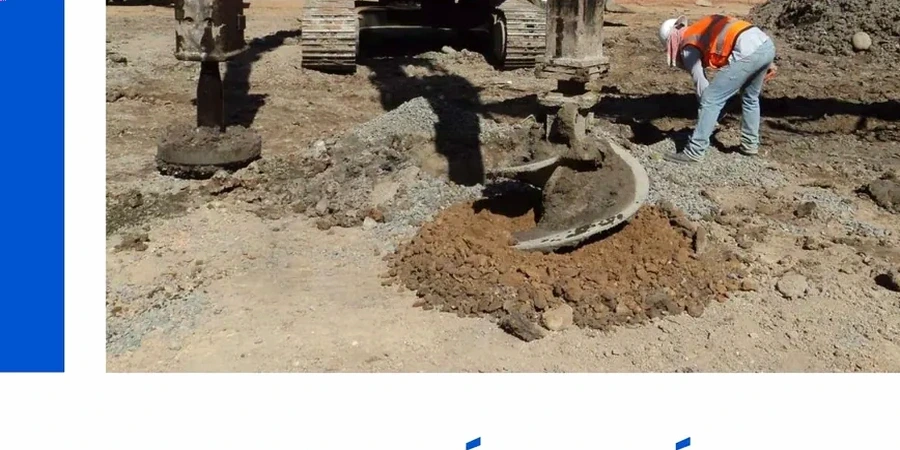
Live process video
Local geotechnical conditions in Surprise Arizona
The vibro-replacement rig that rolls onto a Surprise site is a substantial piece of equipment: a crawler-mounted leader with an electric or hydraulic vibrator hanging from the boom, fed by a loader that keeps the stone hopper full. The probe penetrates under its own weight and vibration, forming a hole that gets backfilled in controlled lifts. If the operator ignores changes in vibration amperage while passing through a buried paleochannel—common in the El Mirage Road corridor—the column can neck down or lose continuity, creating a soft spot that shows up later as differential settlement. The real risk is not the machine itself, but the decision to skip a pre-production trial column. Without it, the designer is guessing on spacing, and the result is either an overconservative grid that wastes aggregate or an undersized one that fails to limit total settlement below one inch.
Our services
The stone column work we deliver in Surprise is backed by a full geotechnical program that starts long before the vibrator rig arrives on site. Our laboratory holds ISO/IEC 17025 accreditation for soil classification and strength testing, which means the design parameters you get are defensible under Maricopa County plan review. Two service packages cover the majority of West Valley projects:
Vibro-Replacement Design & Installation
Complete stone column design package including subsurface exploration, settlement analysis with unit cell modeling, liquefaction mitigation checks per Seed & Idriss methodology, and full-time field oversight during column installation. We carry out signed, sealed reports for your building permit submission.
Post-Installation Verification Testing
Independent modulus and bearing capacity confirmation using plate load tests, multi-channel surface wave profiling, and SPT borings between columns. We verify that the treated ground meets the performance specification before structural concrete is placed.
Common questions
What does stone column design cost for a typical residential or light commercial site in Surprise?
For a single-family lot or small commercial pad, design and verification typically run between US$1,340 and US$5,780 depending on the number of borings, column count, and whether a full-scale load test is required. Sites with deeper soft zones or tighter access constraints fall toward the upper end.
How do you confirm the stone columns actually improved the ground?
We run a combination of post-treatment SPT borings between columns to measure blow count increase and plate load tests directly on top of selected columns. The plate load test follows ASTM D1143 procedures and gives us a direct load-settlement curve that we compare against the design bearing pressure. Surface wave geophysics can also map stiffness improvement across the entire grid.
Are stone columns effective for controlling settlement in the collapsible soils we have in Surprise?
Yes, and that’s one of their strongest applications in this part of the Valley. The vibro-replacement process densifies the surrounding soil horizontally while the stone column itself creates a stiff vertical drain path. For collapsible silty sands that would settle six or eight inches under a conventional footing, a properly spaced column grid typically reduces total settlement below one inch, which is acceptable for most slab-on-grade and lightly reinforced mat foundations.