The soil profile beneath Surprise is anything but uniform. Drive from the older Original Town Site toward the newer developments north of Bell Road, and you move from loose alluvial fans into dense, heavily cemented conglomerates. That shift changes everything for a deep excavation. The geotechnical design of deep excavations here must anticipate abrupt transitions—one moment you are cutting through sandy silts, the next you hit a caliche cap hard enough to challenge standard augers. In our expertise, the real variable is not just depth; it is the degree of cementation. A CPT test can trace these transitions continuously, but when refusal kicks in early, we often rely on SPT drilling with heavy-duty equipment to punch through the hardpan and sample the softer lenses that sometimes lurk below.
In Surprise, the biggest risk is not the depth of the hole but the false confidence that comes from hitting a hard caliche layer early.
Technical details of the service in Surprise Arizona
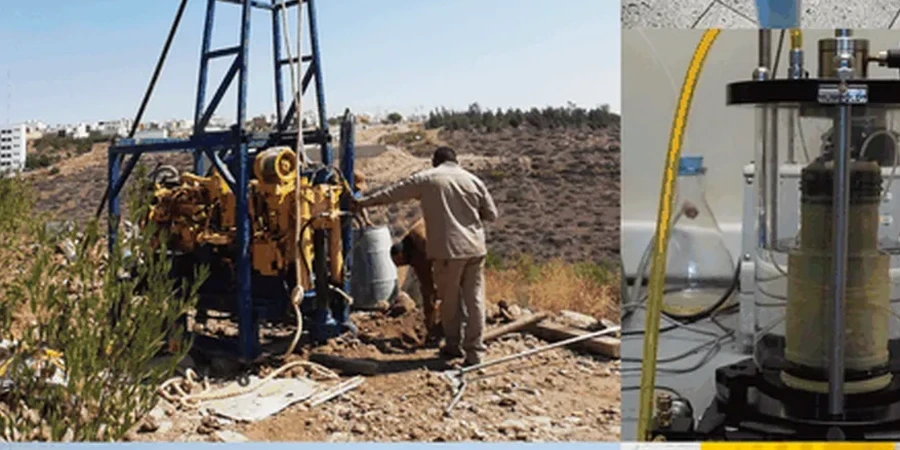
Local geotechnical conditions in Surprise Arizona
With a population now exceeding 160,000, Surprise has pushed infrastructure into areas where the subsurface map is still being written. The 1935 Cedar Mountain earthquake—though centered near the Colorado Plateau—reminded engineers that the Basin and Range province transmits energy efficiently through the deep alluvium. A collapse during deep excavation can propagate rapidly in these granular deposits. The geotechnical design of deep excavations here must include a rigorous observational method. We install inclinometers and settlement points as a standard layer of risk control. A seismic refraction survey before the first shovel hits the ground helps identify buried paleochannels that could daylight into the excavation wall, turning a dry cut into a slurry without warning.
Our services
Our scope for deep excavations in Maricopa County covers the full cycle from pre-design investigation to construction-phase monitoring:
Shoring System Design
Complete structural design of soldier pile, secant pile, or soil nail walls tailored to cemented desert soils.
Tieback Load Testing
Performance and proof testing per PTI recommendations to verify bond zone capacity in caliche and gravels.
Excavation Impact Assessment
Settlement analysis for adjacent structures using finite element modeling to predict ground loss.
Construction Phase Monitoring
Installation of inclinometers, piezometers, and survey points with weekly reporting during the dig.
Common questions
How deep can you excavate before needing shoring in Surprise?
OSHA requires protective systems for any excavation deeper than 5 feet unless it is cut entirely into stable rock. In Surprise, the cemented caliche can sometimes be classified as stable rock by a geotechnical engineer, but only after a site-specific evaluation. For cuts in sandy gravels, shoring is mandatory at 5 feet.
What is the typical cost range for the geotechnical design of a deep excavation here?
The engineering design portion usually falls between US$2,280 and US$9,480 depending on the excavation depth, complexity of the subsurface profile, and the number of tieback levels required. This scope includes the shoring calculations, construction drawings, and observation methodology.
Does caliche remove the need for tiebacks in a deep cut?
Not necessarily. While caliche is strong in compression, it often contains vertical fissures and can behave like an overconsolidated clay. If the cut height exceeds the tensile strength of the caliche beam, tiebacks are still needed to prevent a block failure along the fissures.
How do you handle the expansive clay lenses found near the White Tanks?
We control moisture by sealing the exposed face with shotcrete immediately after cutting. We also design a drainage blanket behind the wall to intercept monsoon runoff. Any delay between excavation and facing can let the clay dry out and crack, which compromises the shoring load path.
What is the groundwater situation in Surprise?
Groundwater across most of Surprise sits deeper than 100 feet, which benefits deep excavation work. However, perched water can appear in isolated sand lenses after heavy irrigation or monsoon storms. We always install a few vibrating wire piezometers to detect these transient pockets before they cause a blowout at the excavation bottom.