A recent commercial project along Bell Road near Surprise Stadium ran into a familiar headache: a 22-foot excavation in stiff, overconsolidated clay that started showing tension cracks within 48 hours of cutting. The contractor had soldier piles in place, but the lateral movement wouldn’t stop until we designed a multi-level anchor system with active prestressing in the upper row to lock in the soil mass immediately. That scenario repeats itself across Surprise Arizona, especially where the upper 15 feet of ground alternates between sandy silts and highly plastic clays deposited by the ancestral Agua Fria River. Our approach combines active anchors for immediate deformation control and passive anchors for long-term load redistribution, always tied to the actual stratigraphy we log on site. Before finalizing anchor geometry, it is standard practice to refine the soil profile with an in-situ permeability test when groundwater proximity affects bond length calculations in the deeper horizons.
In Surprise’s caliche-layered profiles, unbonded length typically extends 5 feet past the theoretical failure plane to prevent progressive debonding during cyclic loading.
Technical details of the service in Surprise Arizona
Local geotechnical conditions in Surprise Arizona
The Surprise Arizona subsurface presents a specific risk for anchor design: the transition zone between the upper Quaternary alluvium and the deeper, heavily cemented caliche can act as a preferential slip surface if anchors are bonded too close to that interface. We have pulled proof-test records from sites near the White Tank Mountain foothills where bond stresses dropped abruptly when the grout column intersected a clay seam within the caliche — something that standard borings can miss if the sampling interval is too wide. The IBC 2021 and ASCE 7-22 require a minimum factor of safety of 2.0 against tendon yield for permanent anchors, and we extend that to 2.5 in areas with documented expansive soil behavior, which includes much of Surprise. Creep testing over a 60-minute hold period at 133 percent of design load is mandatory on every production anchor we install, and we run it again if the log shows any deviation from the expected strata. When anchor heads are buried behind a finished wall, access for restressing is gone forever, so the initial lock-off tension must account for relaxation losses in the strand and long-term creep in the surrounding ground.
Our services
We deliver anchor design and verification operations across Surprise Arizona that go beyond sizing a tendon on paper. Every project starts with a site-specific geotechnical review and a clear definition of whether active prestressing, passive resistance, or a hybrid layout makes sense for the excavation depth and adjacent structures. Our field team handles installation supervision, lift-off testing, and long-term monitoring documentation.
Design of Active Prestressed Anchor Systems
Full anchor geometry with unbonded length calculation, bond zone verification in local caliche, and lock-off sequence protocols aligned with IBC performance criteria.
Passive Anchor and Soil Nail Layout
Design of grouted passive tendons for permanent retaining walls in the expansive clays and sandy silts that characterize the Surprise Arizona basin fill.
Proof and Performance Testing Programs
On-site supervision of creep tests, lift-off verification, and extended monitoring of load cells on critical anchors following PTI DC35.1 procedures.
Excavation Support and Tieback Coordination
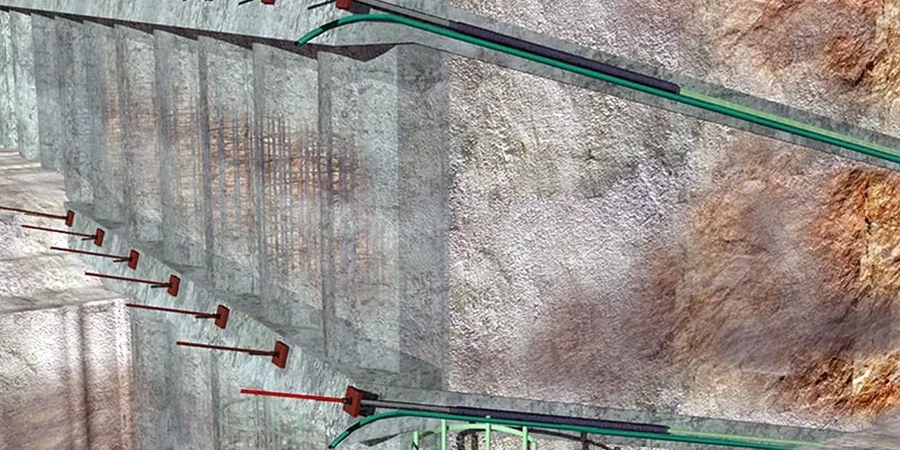
Integration of anchor design with soldier pile, secant pile, or shotcrete facing systems, including staged excavation sequencing and groundwater control measures.
Common questions
When does Surprise Arizona require active anchors instead of passive ones?
Active anchors become necessary when lateral movement must be limited to less than half an inch, which is common for excavations adjacent to existing buildings, utility corridors, or along arterial roads like Grand Avenue. In Surprise’s stiff clays, passive anchors need measurable displacement to develop resistance, and that deformation can exceed what a neighboring structure tolerates. We specify active prestressed anchors for the top row in most urban excavations and switch to passive anchors at deeper levels where some movement is acceptable and the soil provides higher confinement.
What is the typical cost range for anchor design and testing in Surprise?
Anchor design and field verification operations in Surprise Arizona generally range from US$1,040 to US$4,070 depending on the number of anchor levels, whether active or passive systems are specified, and the extent of proof testing required. Projects with multiple rows of active anchors and long-term load monitoring fall toward the upper end of that range, while simpler passive layouts with standard acceptance testing are more economical.
How deep do anchors need to go in the caliche layers around Surprise?
The bonded length must extend well past the theoretical active wedge into competent material, and in Surprise’s caliche that typically means penetrating at least 10 to 15 feet into the cemented zone. We verify the caliche continuity through drilling parameters and core recovery because thin clay partings within the caliche can reduce bond capacity significantly. The unbonded length runs from the bearing plate through the active soil zone and an additional 5 feet into the stable ground to certify the tendon can elongate without pulling the grout column out of the bond zone.
What testing is mandatory for permanent anchors under IBC?
The IBC 2021 mandates proof testing on every permanent anchor at 133 percent of the design load for a 10-minute hold period, with creep measurement recorded at 1, 3, 6, and 10 minutes. If creep exceeds 0.08 inches during the last 6 minutes, the anchor must be retested or replaced. On active anchors we also perform lift-off tests after lock-off to confirm the residual load matches the specified lock-off value within 5 percent tolerance. For projects in Surprise with expansive soil potential, we extend the hold to 60 minutes on a representative sample of anchors.