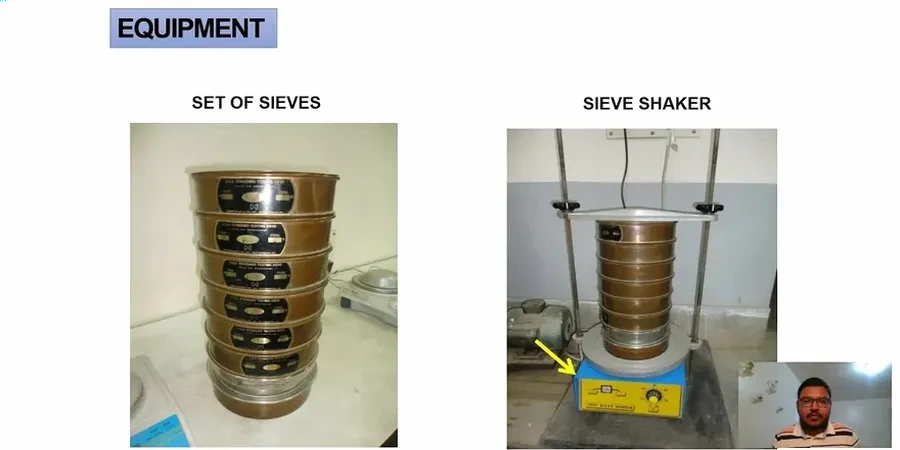
The heart of our Surprise grain size analysis runs on two parallel systems: a full-height Ro-Tap shaker stacked with 8-inch brass sieves from No. 4 down to No. 200, and a 152H hydrometer settling in a constant-temperature bath at 20°C. That combination matters here. Surprise sits at 1,175 feet elevation in the Sonoran Desert, where flash-flood deposits and wind-blown fines create soils that can look like clean sand but carry enough silt to fail a compaction spec. Sieves alone miss the fraction passing the No. 200. Adding the hydrometer per ASTM D7928 captures the full curve down to the clay range, giving you a defensible USCS classification for foundation submittals and earthwork QA. In a city that added over 30,000 residents between 2010 and 2020, grading contractors need lab data that holds up when Maricopa County reviewers ask for gradation curves. A single sand cone density field test paired with a full hydrometer curve confirms whether your fill actually meets the 95% modified Proctor spec you bid on.
A sieve curve without the hydrometer tail is a half-read story — and in Surprise basin soils, the fine fraction often controls the engineering outcome.
Technical details of the service in Surprise Arizona
Local geotechnical conditions in Surprise Arizona
Surprise recorded a population of roughly 160,000 in the 2024 census estimates, and a significant share of new housing sits on Holocene-age alluvial fans extending from the White Tank Mountains. Those fans contain interbedded lenses of clayey silt deposited by sheet flooding — material that looks uniform in a bucket but carries a collapse potential when wetted under foundation load. Without a hydrometer curve, you miss the diagnostic fine tail that flags collapsible soil behavior. ASTM D2487 classification using full gradation data lets the geotechnical engineer apply the correct collapse-susceptibility criteria from the Arizona Geological Survey's regional mapping. The cost of skipping the hydrometer is a floor slab crack pattern that shows up two monsoon seasons after the certificate of occupancy. We run the curve, we flag the fines content, and we deliver the data as a clean PDF report with the lab's AASHTO accreditation number on every page — ready for the city's third-party review.
Our services
Our Surprise materials lab offers two gradation packages matched to the project phase — from preliminary site characterization to full earthwork QA with USCS classification.
Standard Sieve + Hydrometer Package
Combined ASTM D6913/D7928 on a single split sample. Includes wash through No. 200, oven-dried sieve stack, 24-hour hydrometer sedimentation reading series, and a plotted gradation curve with D10, D30, D60, Cu, and Cc calculated. Delivered as a signed PDF with lab accreditation documentation. This is the package most Surprise grading contractors request for IBC submittals.
Rush-Track Gradation for Earthwork QA
Same combined method, prioritized to a 24-hour turnaround for active fill operations. We accept samples until 4 PM and email the full curve plus USCS group symbol by close of the next business day. Useful when compaction curve results from a nuclear gauge need the supporting gradation data before the lift can be signed off.
Common questions
How much does a combined sieve and hydrometer test cost in Surprise?
A full ASTM D6913 + D7928 combined analysis typically runs between $90 and $180 per sample in the Surprise area. The price depends on sample volume — single residential lots versus multi-sample commercial earthwork packages — and whether you need the standard 48-hour turnaround or rush processing. We send a written quote before any work begins, with no hidden line items.
When does IBC require a hydrometer instead of just a sieve analysis?
IBC Section 1803.5.3 requires soil classification based on the Unified Soil Classification System (ASTM D2487). USCS classification demands the full gradation curve, including the fines fraction passing the No. 200 sieve. If more than 5% of the sample passes the No. 200, a hydrometer analysis per ASTM D7928 is necessary to correctly assign the group symbol — without it, you risk misclassifying a silty sand as clean sand, which can lead to an unconservative bearing capacity assumption.
What sample size do you need for a grain size test?
For typical Surprise basin soils — mostly sands with variable silt — we ask for a minimum 500-gram representative sample in a sealed plastic bag. If gravel particles larger than 3 inches are present, we may request additional material for a parallel coarse-fraction analysis. The sample must be undisturbed enough to preserve the natural gradation; material scooped from the top of a stockpile is not acceptable because segregation skews the curve.
How long does the hydrometer portion of the test take?
The sedimentation reading sequence spans a minimum of 24 hours, with readings taken at specific time intervals — typically 0.5, 1, 2, 5, 15, 30, 60, 240, and 1,440 minutes — after mixing. Combined with sieve analysis, the complete test generally reports within 48 hours. Our rush service compresses the administrative and reporting steps to deliver results within 24 hours of sample receipt. More info.