Surprise, Arizona, evolved from a small agricultural outpost founded by Homer C. Ludden in 1938 into one of the fastest-growing suburbs in the Phoenix metropolitan area, now home to over 160,000 residents. This explosive growth pushed development into the floodplains of the Agua Fria River and onto the coarse alluvial fans that descend from the White Tank Mountains, where subsurface conditions shift dramatically within a single parcel. Our laboratory team has performed in-situ permeability testing across hundreds of these sites, and we know that assuming uniform infiltration rates in Surprise is a costly mistake. Whether a project involves stormwater infiltration galleries for a new master-planned community in Surprise or dewatering a deep excavation for a water reclamation facility, the Lefranc and Lugeon tests carry out the direct measurement of hydraulic conductivity that empirical correlations simply cannot replicate. We complement these field tests with grain-size analysis in our Surprise laboratory when the stratigraphy includes interbedded silts and sandy gravels, which are common in the basin-fill deposits underlying much of the city.
A single Lefranc test in Surprise's heterogeneous alluvium can reveal permeability contrasts of two orders of magnitude within the same borehole, something no laboratory permeameter can capture.
Technical details of the service in Surprise Arizona
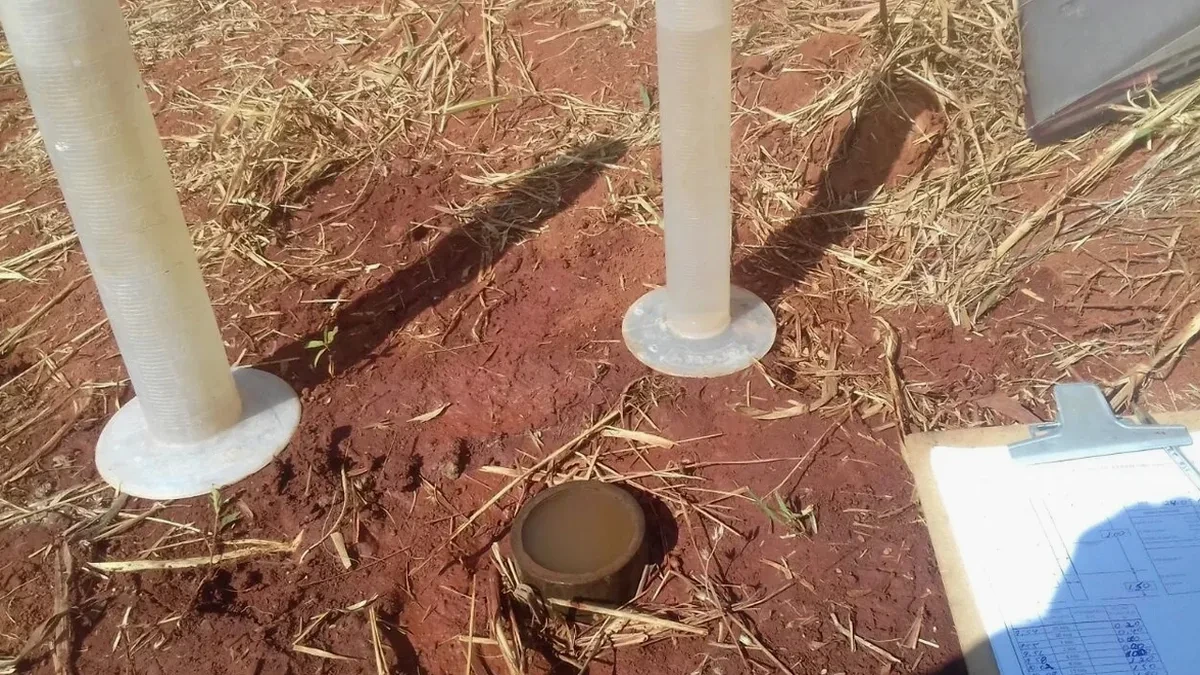
Live process video
Local geotechnical conditions in Surprise Arizona
The equipment package we deploy in Surprise centers on a double-packer assembly with inflatable rubber glands rated for 150 psi, connected to a calibrated flowmeter and pressure transducer array that logs data every 2 seconds onto a ruggedized tablet. The packers are lowered through hollow-stem augers or NQ drill rods depending on whether we are testing in soil or rock, and the inflation lines run parallel to the water injection line so we can adjust the seal without tripping out of the hole. The main failure mode we guard against in Surprise is packer bypass along the borehole wall in the granular zone above the caliche, which produces artificially high flow readings that mimic a more permeable formation. We mitigate this by overdrilling the test zone, casing off the upper materials with a tight bentonite seal, and verifying packer seating with a low-pressure hold test before starting the permeability stage. A secondary risk is siltation of the test interval during drilling, which we address by flushing the hole with clear water and allowing the formation to equilibrate until turbidity drops below 5 NTU.
Our services
Our field permeability testing operations in Surprise are integrated into comprehensive geotechnical investigation programs tailored to the specific regulatory and hydrogeologic conditions of the West Valley. Each test program includes pre-field coordination with the design team, real-time data review by a licensed professional engineer, and a signed report suitable for submittal to the City of Surprise building department.
Lefranc constant-head permeability testing
Direct measurement of hydraulic conductivity in granular soils above the water table using a constant water level maintained in the borehole. We record steady-state flow rates at multiple head increments to verify Darcian behavior before computing k-values.
Lugeon packer testing in fractured rock
Five-stage pressure tests in bedrock following the Houlsby interpretation method. Each stage lasts 10 minutes, with flow and pressure logged continuously to identify fracture dilation, washout, or laminar flow regimes characteristic of the cemented caliche common in Surprise.
Falling-head tests in low-permeability materials
When the formation is too tight for constant-head methods, we perform falling-head Lefranc tests with a standpipe and pressure transducer, measuring the decay curve over time to calculate k-values in silts and clayey sands.
Integrated dewatering feasibility studies
Combining multiple in-situ permeability tests with groundwater monitoring data to produce dewatering flow rate estimates, radius-of-influence calculations, and well-point spacing recommendations for excavations in Surprise's perched aquifer systems.
Common questions
What is the difference between a Lefranc test and a Lugeon test?
The Lefranc test measures hydraulic conductivity in soil by injecting or extracting water at a constant or falling head within an uncased borehole section, and it is typically used in granular or silty materials above the water table. The Lugeon test is designed for fractured rock; water is injected under pressure in five stages through a packer-isolated interval, and the resulting flow-pressure relationship is expressed in Lugeon units (1 Lu ≈ 1.3×10⁻⁵ cm/s). In Surprise, we often apply both methods on the same project when the stratigraphy transitions from basin-fill alluvium into weathered bedrock.
How much does a field permeability test cost in Surprise Arizona?
A single Lefranc or Lugeon test in Surprise typically ranges from US$540 to US$1,140, depending on the number of test intervals per borehole, the depth of the test zone, and whether packer inflation requires an additional trip for setup. Multi-depth testing programs that combine three or more zones per borehole benefit from reduced mobilization costs per test. Every proposal includes a detailed breakdown of drilling time, equipment rates, and reporting hours.
How long does a field permeability test take to complete on site?
A single Lefranc test interval, once the borehole is advanced and the test zone prepared, requires approximately 45 to 90 minutes of active testing to achieve steady-state conditions and complete the required head increments. A full five-stage Lugeon test typically takes 90 to 120 minutes per zone, including packer inflation, stage execution, and deflation. The total site time depends on the number of test zones and the drilling depth, but a typical two-zone permeability investigation in Surprise is completed within one working day.
What standards govern in-situ permeability testing for IBC compliance in Arizona?
The International Building Code (IBC 2024) references ASTM D6391-11 for field measurement of hydraulic conductivity as part of the geotechnical investigation required under Section 1803. Additionally, ASCE 7-22 provides load combinations and groundwater considerations for foundation design. For projects in Surprise involving fractured rock, we also follow the procedures documented in the USBR Earth Manual, which align with the Lugeon interpretation methodology used by our field crews.