A distribution center off Grand Avenue had poured its third loading dock slab in eight years. Cracks spiderwebbed out from the dock leveler pits within two seasons. The problem was not the concrete mix. It was the design. In Surprise, where the diurnal temperature swing can hit 40 degrees Fahrenheit and the native soil is a mix of caliche and expansive clay, rigid pavement demands more than a standard section from a county detail. We see this pattern repeatedly: slabs that curl, joints that spall, and subgrades that shrink during the dry months then heave after a monsoon downpour. That project taught us that in the West Valley, a pavement design has to start with a clear understanding of the underlying ground, not just the traffic index. Our approach to rigid pavement design integrates the geotechnical reality of northwest Maricopa County with the structural demands of heavy logistics traffic. When the subgrade reads high on plasticity, we often recommend a review of the Atterberg limits before finalizing the concrete thickness, because what looks like a standard clay can behave very differently once water gets beneath the slab.
A rigid pavement in Surprise is a thermal machine as much as a structural one: curl stress from a 115-degree surface can equal the stress from a 30-kip axle load.
Technical details of the service in Surprise Arizona
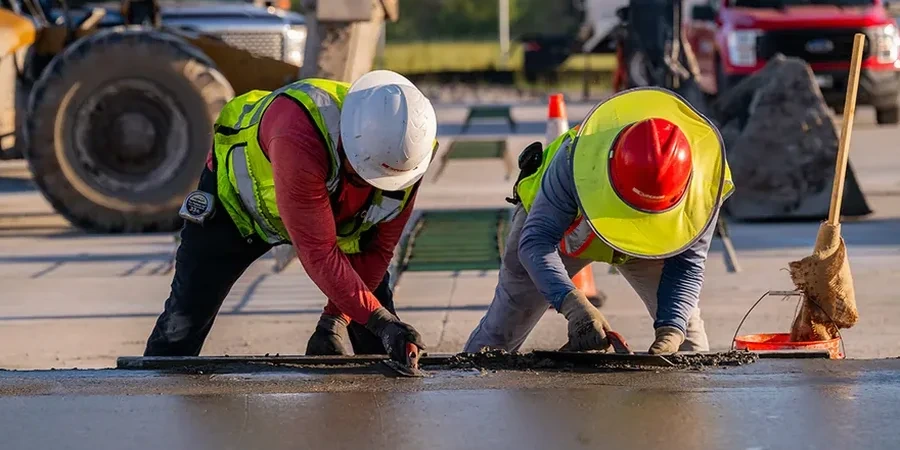
Local geotechnical conditions in Surprise Arizona
In our expertise, the pavement failures we investigate in Surprise almost always trace back to one of three things: uncontrolled subgrade moisture, undersized base drainage, or joints sealed after the damage has already started. The caliche that underlies much of the city can look like solid rock in a test pit but soften dramatically when the monsoon water ponds against the slab edge. We have measured a drop in subgrade support from k=200 pci to below 80 pci in one season where the downspouts discharged right at the pavement perimeter. Another risk specific to rigid pavement in this climate is alkali-silica reaction accelerated by high curing temperatures. A mix design that works fine in Flagstaff can develop map cracking here within five years if the aggregates are not tested for reactivity. We address these risks by specifying moisture-conditioned base layers, positive drainage away from the slab, and sealant materials rated for Arizona's UV exposure. The cost of a well-designed pavement is in the engineering hours upfront; the cost of a poorly designed one is in the replacement concrete, the downtime, and the forklift tires.
Our services
Our rigid pavement design operations in Surprise cover the full sequence from geotechnical investigation to construction specifications. We tailor each package to the project scale, whether it is a single fueling island apron or a 40-acre intermodal yard.
Subgrade Evaluation and k-value Testing
Field plate load tests on prepared subgrade and base to determine the modulus of subgrade reaction, plus laboratory classification including expansion index and sulfate content of Surprise soils.
Concrete Slab Structural Design
Thickness design using PCA and Westergaard methods for the specific axle loads and tire pressures of your operation, with joint layout and reinforcement detailing per ACI 360.
Construction Phase Support
Review of mix designs for hot-weather placement, observation of subgrade proof-rolling, and joint installation verification to ensure the design assumptions translate to the finished pavement.
Common questions
What thickness of concrete slab do I need for a truck yard in Surprise?
It depends on the wheel loads, not just the vehicle type. A yard handling dump trucks with 20-kip single axle loads on a k=150 pci subgrade might need 7 to 8 inches of unreinforced concrete. A facility with reach stackers can require 10 to 12 inches. We determine the exact thickness by running the load configurations through the PCA design method rather than using a generic table, because the local aggregate properties and the monsoon moisture effects shift the fatigue consumption curve.
How much does rigid pavement design cost for a project in Surprise?
For a typical commercial project in Surprise, a complete rigid pavement design package that includes subgrade investigation, k-value determination, thickness design, and joint layout runs between US$1,810 and US$6,350. The range depends on the size of the paved area, the number of plate load tests required, and whether we are designing for standard truck traffic or heavy industrial loads like gantry cranes or container handlers.
Why do concrete slabs in Surprise crack more than in cooler climates?
The main driver is thermal differential. A slab in Surprise can reach 140 degrees Fahrenheit on the surface while the bottom stays 40 degrees cooler, creating enough curl stress to crack the slab under its own weight if the joints are too far apart. Add to that the high evaporation rate during placement, which increases plastic shrinkage cracking, and the expansive clay subgrade that moves with the monsoon moisture. Our designs counteract these by tightening joint spacing, specifying moist curing for at least seven days, and providing a drainage layer that keeps water from ponding under the slab.
Do I need dowel bars at every joint for a warehouse floor?
Not at every joint, but at the construction joints and any contraction joint where you need load transfer to prevent faulting. For a warehouse with narrow-aisle forklifts running the same path thousands of times, we typically dowel all transverse contraction joints in the aisles. The dowel diameter and spacing follow ACI 360 recommendations, which tie directly to the slab thickness. In areas with only pedestrian traffic, we can omit the dowels and rely on aggregate interlock for the first couple of years.
What is the difference between rigid and flexible pavement for a Surprise parking lot?
Rigid pavement distributes the wheel load over a larger area of subgrade through the bending stiffness of the concrete slab, so it tolerates weaker subgrades better than flexible asphalt pavement. In Surprise, where the subgrade can go from very stiff in the dry season to soft after monsoon rains, this is a practical advantage. Rigid pavement also reflects less heat and does not soften in summer, but it costs more upfront. Flexible pavement is less expensive initially, but requires more frequent maintenance under heavy truck traffic and can rut in extreme heat. The right choice depends on the subgrade conditions, the traffic mix, and the owner's maintenance budget over 20 years.