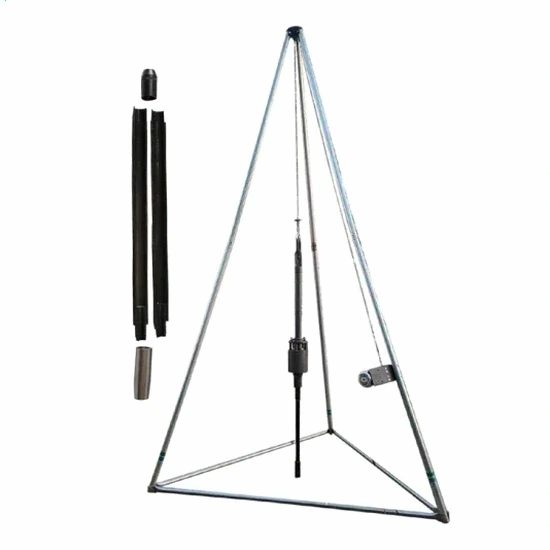
The CME-75 track rig rolls onto the lot just east of the White Tank Mountains, and within twenty minutes the automatic hammer starts dropping — 140 pounds falling 30 inches, blow after blow. That rhythmic thud is what a reliable SPT sounds like in Surprise, Arizona. We mobilize our drilling equipment across the entire Loop 303 corridor and into the older subdivisions off Bell Road because the subsurface here doesn't read textbooks. Surprise sits on a mix of mid-to-late Pleistocene alluvial fans, interbedded with caliche layers that can fool a shallow auger in seconds. Running the SPT drilling with a split-spoon sampler per ASTM D1586 gives us N-values and physical samples from every 5-foot interval — data that structural engineers need before they size footings or floor slabs. In a city where summer ground temperatures push past 140°F at the surface, getting undisturbed blow-count data from 20, 30, or 50 feet down is the only way to separate stiff natural deposits from moisture-starved fill.
Blow counts don't lie — but caliche can. That's why every SPT sampler we pull gets a field classification before it ever leaves the site.
Technical details of the service in Surprise Arizona
Live process video
Local geotechnical conditions in Surprise Arizona
The Sonoran Desert doesn't negotiate — you either understand the soil profile or you pay for it later. Surprise gets roughly 9 inches of rain a year, most of it in violent monsoon bursts between July and September. Those storms turn dry washes into rivers inside an hour, and if your site sits within a mapped floodplain or near the Agua Fria River's historic meander zone, the upper 10 feet of alluvium can swing from cohesionless sand to low-plasticity silt across the width of a single building pad. A shallow SPT refusal on caliche might tempt a contractor to overestimate bearing capacity, but what looks like rock is often a discontinuous lens floating in softer material. We've pulled split spoons where the caliche shattered at 50 blows for six inches and then dropped to N=12 in the underlying silty sand — exactly the kind of contrast that triggers differential settlement if footings aren't designed with that variability in mind. The IBC requires site-specific investigation for all but the lightest structures, and in Surprise's expansive-collapsible soil interface zones, skipping the SPT means gambling with slab cracks and warranty claims.
Our services
Every SPT borehole in Surprise generates a soil profile, but what you do with that profile depends on your project. Here are the two most common applications we run alongside our standard penetration testing in the West Valley.
Footing Design Verification
We correlate N-values with allowable bearing pressure and expected settlement under isolated and strip footings. For Surprise's typical alluvial deposits we carry out net allowable bearing values calibrated to IBC presumptive load-bearing tables, adjusted for actual blow-count profiles and lab classification of recovered samples. This package feeds directly into the structural engineer's foundation plan and reduces over-excavation surprises.
Liquefaction Screening for Seismic Design
Maricopa County sits in a moderate seismic hazard zone, and Surprise's shallow groundwater in some western basins raises liquefaction potential. We run SPT-based liquefaction triggering analyses using the simplified procedure (Seed & Idriss framework with NCEER updates), applying fines-content corrections from lab testing and calculating factors of safety against cyclic softening for design earthquake scenarios.
Common questions
How much does an SPT investigation cost for a typical Surprise residential lot?
For a standard single-family lot under an acre in Surprise, a two-borehole SPT program with a track-mounted rig typically runs between US$570 and US$860 per borehole, depending on total depth, access constraints, and whether you need a full lab suite or just field logging. Mobilization within the Loop 303 corridor is usually straightforward, but tight backyard access or aggressive caliche that slows drilling can push the upper end of that range.
What's the difference between an SPT and a CPT for Surprise soil conditions?
SPT gives you a physical soil sample from each 5-foot interval — essential in Surprise where caliche fragments and gravel stringers need visual classification. CPT provides a continuous electronic profile of tip resistance and sleeve friction without sampling, which is faster and excellent for tracking thin silt seams. In practice, we often use SPT as the primary exploration method because the sample recovery lets us run lab tests (Atterberg limits, grain size) on the same material, then supplement with CPT pushes in areas where we need higher-resolution stratigraphic definition between boreholes.