The biggest mistake we see in Surprise isn't skipping the soil report. It's specifying a fixed-base building where base isolation would have cut the structural steel tonnage by 20 percent. The math is straightforward: less steel, smaller footings, lower construction cost. Surprise sits in Maricopa County, about 20 miles northwest of Phoenix, with a population nearing 160,000 that keeps pushing development west into the White Tank Mountain foothills. Those alluvial fan deposits amplify short-period ground motion differently than the valley floor. When we run the cost-benefit on a three-story medical office or a fire station, the isolation system often pays for itself before the certificate of occupancy is signed. The seismic microzonation work we do in the West Valley confirms that site class varies block by block out here, and that variability is exactly why a one-size-fits-all foundation strategy leaves money on the table.
A well-designed isolation system shifts the fundamental period past 2.0 seconds, where spectral acceleration drops sharply. That single shift reduces the seismic force demand by 40 to 60 percent.
Technical details of the service in Surprise Arizona
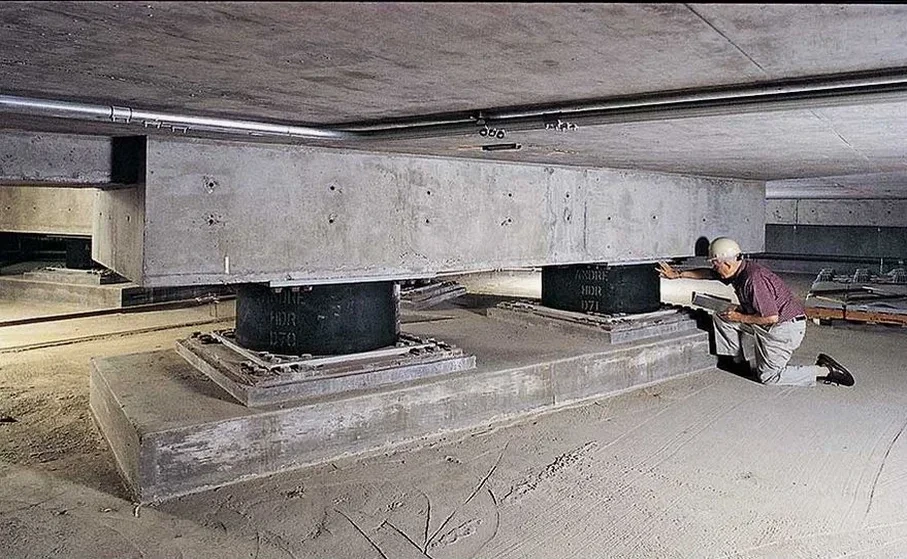
Local geotechnical conditions in Surprise Arizona
ASCE 7-22 Chapter 17 governs seismic isolation design in the United States, and it requires peer review by an independent registered design professional. That is not a suggestion. For Risk Category III and IV structures in Surprise, the building official will not issue a permit without the peer review report. The isolation system must remain stable at the MCER displacement plus an accidental torsion amplification. The moat wall must accommodate that displacement plus a 24-inch minimum clearance per IBC 2021 Section 1705.15. The utility connections crossing the isolation plane require flexible couplings rated for the full design displacement. Our quality assurance program follows the ASCE 7 prototype and production testing sequence exactly: three fully reversed cycles at 1.0 MCE displacement, then 10 cycles at 0.67 MCE, then thermal cycling if specified. Every bearing gets a production test before shipping. No exceptions.
Our services
We deliver base isolation design as part of a complete seismic risk management package. The isolation system is the centerpiece, and the supporting operations confirm that the ground underneath can handle the concentrated bearing loads.
Isolation System Design and Peer Review Coordination
Full nonlinear time-history analysis with bearing selection, moat wall detailing, and utility interface design. We coordinate the independent peer review required by ASCE 7 Chapter 17 and manage the prototype test submittal package.
Geotechnical Investigation for Isolator Foundation Design
Site-specific borings to 60 feet with shear wave velocity measurement. We carry out bearing capacity, settlement analysis, and modulus of subgrade reaction values at each isolator pad, accounting for the high axial loads and low overturning moment characteristic of base-isolated structures.
Common questions
What does base isolation design cost for a project in Surprise, AZ?
For a typical commercial building in Surprise, the structural design fee for the isolation system ranges from US$4,080 to US$7,310. This covers the nonlinear time-history analysis, bearing specification, peer review coordination, and construction document preparation. The cost of the bearings themselves is separate and depends on the number, diameter, and type specified.
Is base isolation practical for a two-story building, or is it only for high-rises?
It is absolutely practical for low-rise buildings, and in Surprise, two-to-four-story structures are the most common candidates. The period shift benefit works at any height. For a two-story essential facility, the reduction in seismic force often eliminates the need for special moment frames, which simplifies construction and reduces the structural steel package cost.
How long does the design and peer review process take?
Plan on 8 to 12 weeks from notice to proceed to permit-ready documents. The critical path is usually the prototype bearing test schedule. We submit the design criteria to the peer reviewer at the 30 percent stage, incorporate comments by 60 percent, and finalize the construction documents once the bearing test report is approved.
What maintenance does a base isolation system require over the building's life?
The bearings themselves are zero-maintenance. The moat wall covers need inspection every 5 years to confirm they are free of debris and can slide without binding. Utility flexible couplings should be inspected on the same cycle. We carry out an inspection checklist and a maintenance manual as part of the construction closeout package.