When we mobilize a track excavator or backhoe to project sites across Surprise, Arizona, our primary objective is to expose the subsurface stratigraphy in its undisturbed state. A single bucket cut through the upper horizon often reveals the transitional contact between the silty sand alluvium of the Hassayampa River plain and the underlying Stage III petrocalcic horizons that define much of the construction landscape in Maricopa County’s western expansion. These exploratory test pits allow our field engineers to physically enter the excavation at depths between 8 and 14 feet, logging the soil profile in accordance with ASTM D2488, collecting bulk samples for laboratory index testing, and assessing the depth to the caliche duripan—an interface that frequently dictates footing bearing capacity and excavation effort in Surprise neighborhoods from Marley Park to Ashton Ranch.
Direct visual inspection of a caliche duripan in a test pit eliminates the interpretation ambiguity that plagues indirect methods in the Hassayampa Basin.
Technical details of the service in Surprise Arizona
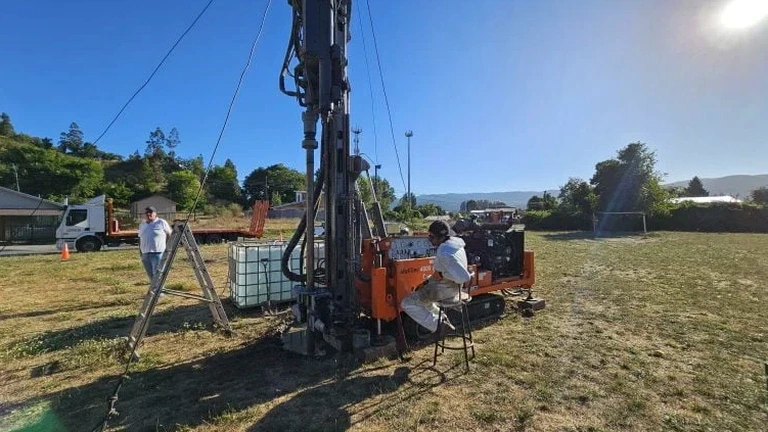
Local geotechnical conditions in Surprise Arizona
A recurring error we observe among contractors in Surprise is assuming that a single test pit near the street will characterize the entire building pad—particularly on lots graded with imported fill over native desert pavement. The caliche surface is notoriously irregular in this part of the Sonoran Desert, often dipping or weathering into solution channels that concentrate water and create soft spots directly beneath slab-on-grade foundations. When an exploratory test pit program is skipped or undersized, the result is differential heave in sulfate-rich soils or unexpected over-excavation costs when the caliche is encountered at depths shallower than the planned footing embedment. The IBC requires that the bearing stratum be inspected in situ, and for Surprise’s geologic conditions, nothing replaces a geotechnical engineer standing at the base of a freshly excavated pit, confirming that the design assumptions match the ground truth before the concrete is placed.
Our services
Our exploratory test pit program in Surprise is designed to carry out a complete package of field observations, sampling, and follow-up laboratory analysis that addresses both the geotechnical and constructability aspects of your project.
Test Pit Excavation and Soil Mapping
We deploy appropriate machinery to excavate pits up to 14 ft deep, log the stratigraphy per ASTM D2488, and document the condition of the caliche duripan with high-resolution photographs and detailed field notes.
Bulk and Undisturbed Sampling
We collect representative disturbed samples from each stratum and, where fine-grained soils are encountered below the caliche, extract Shelby tube samples for unconfined compression and swell-consolidation testing.
Sulfate and Corrosivity Screening
Given the sulfate-rich nature of Surprise's desert soils, we submit samples for chemical analysis including water-soluble sulfate content, pH, and resistivity to define the appropriate concrete exposure class and corrosion protection measures.
Common questions
How deep can an exploratory test pit be excavated in Surprise before encountering refusal on caliche?
The depth to caliche refusal in Surprise varies significantly depending on your location relative to the Hassayampa Basin and the White Tank piedmont. In the alluvial plains near Grand Avenue, we typically encounter Stage II to III petrocalcic horizons between 2 and 6 feet below grade, though the cementation can be fractured enough to excavate through with a standard bucket. Closer to the bajadas in the northern part of the city, the caliche often presents as a massive Stage IV duripan at depths as shallow as 18 inches, requiring a hydraulic breaker attachment for penetration. Our field geologist assesses the hardness class and fracture spacing directly on the pit face to determine whether deeper exploration requires switching to rotary drilling methods.
What is the typical cost range for an exploratory test pit in Surprise, Arizona?
For a single exploratory test pit excavated to depths between 8 and 14 feet in Surprise, with full-time geotechnical logging, photographic documentation, and bulk sampling of each stratum, the cost typically ranges from US$500 to US$960. The final figure depends on equipment access constraints, the presence of massive caliche requiring extended excavation time, and the number of samples submitted for laboratory analysis. A program with multiple pits across a larger parcel naturally achieves a lower unit cost per pit. Each quotation includes OSHA-compliant sloping or shoring design, backfill compaction, and a factual report with the soil profile description.
Can an exploratory test pit replace a standard penetration test boring for foundation design in Surprise?
An exploratory test pit provides critical direct-visual information that an SPT boring cannot—particularly the lateral continuity and fracture pattern of the caliche duripan and the true structure of the soil fabric—but it does not fully replace the need for penetration resistance data in deeper strata. For foundation design in Surprise, we typically recommend combining test pits with companion SPT borings advanced below the caliche cap, especially when the petrocalcic horizon is underlain by compressible silty clays of the Hassayampa formation. The test pit confirms the condition of the bearing stratum at footing depth, while the SPT data quantifies the settlement potential of the deeper layers, giving our engineers a complete profile for shallow foundation analysis. More info.